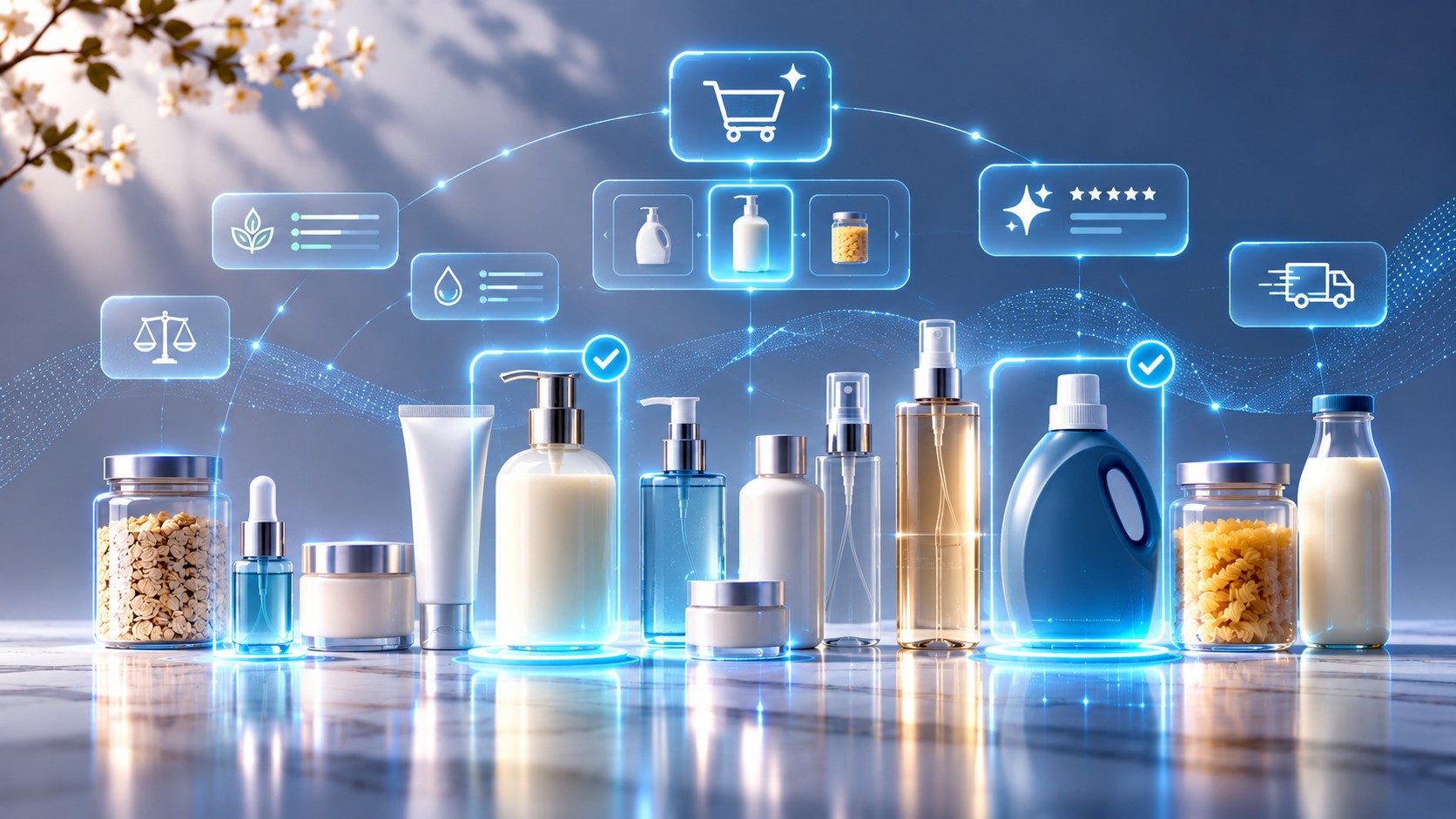
A consumer restocking the pantry no longer needs to open a retailer app, scroll through aisles, and compare labels. A single prompt to an AI assistant, such as "restock breakfast essentials for a family of four," can now handle discovery, comparison, and increasingly, the purchase itself.
This is agentic commerce: AI agents researching, comparing, and buying products on behalf of consumers.
For CPG brands, this changes who they are selling to. The first decision is often made not by a person scanning a shelf, but by an algorithm reading product data. If an AI agent does not select a product, the consumer may never see it.
The question for CPG leaders is no longer whether agentic commerce will shape shopping. It is whether their brands are visible, clear, and trusted when it does.
How Big Is Agentic Commerce?
McKinsey estimates that agentic commerce could orchestrate $3 trillion to $5 trillion in global retail revenue by 2030.
Consumer behavior is already moving in that direction. According to Bain & Company, between 30% and 45% of US consumers already use AI for shopping support, and 64% have used or are open to using AI to complete a purchase.
This is no longer early-adopter behavior. For a growing share of consumers, an AI assistant is becoming the starting point of the shopping journey.
Why Does Agentic Commerce Matter for CPG Brands?
Agentic commerce matters for CPG brands because AI agents increasingly decide which products a shopper sees first, even for routine purchases like groceries. If an agent cannot read, match, or trust a brand’s product information, that brand can drop out of the consideration set before the shopper compares any options.
AI shopping is not limited to electronics or big-ticket items. BCG reports that shopping-related AI use grew 35% in 2025, and consumers increasingly rely on it for routine purchases such as groceries.
That puts CPG directly in the path of the shift. Three changes stand out:
- The funnel collapses: browsing, comparing, and buying increasingly happen in a single interaction, leaving less room for in-store or on-page persuasion
- Missions replace product searches: consumers ask for "quick weeknight dinners" or "a skincare routine for dry skin" rather than naming a brand, so products must clearly match a use case
- Impact varies by category: research-heavy categories such as beauty and personal care feel it first, household essentials are likely to follow, and habit-driven categories such as packaged food may move more slowly but are not immune
These AI-referred shoppers are also high-value. According to Adobe Analytics, in March 2026 traffic from AI assistants to US retail sites converted 42% better than other traffic. A year earlier, it converted 38% worse.
How Do AI Shopping Agents Choose Products?
AI agents do not respond to brand awareness the way people do. They read data, reviews, and claims, then rank products against the consumer’s stated need. A few signals matter most:
- Concrete, specific attributes: "dissolves fully in cold water" gives an agent something to match; "advanced cleaning power" does not
- Consistent product data: titles, ingredients, pack sizes, and claims that match across the brand site, retailer pages, and marketplaces; conflicting details reduce an agent’s confidence
- Review strength: agents read reviews to judge real-world performance, so both volume and substance count
- Machine-readable details: pricing, availability, delivery, and returns presented in formats agents can parse
- Third-party validation: expert reviews, comparisons, and forum discussions that confirm what the brand says about itself
As Bain notes, emotional brand equity still matters, since narratives surface through reviews and commentary. But vague positioning is easily filtered out.
An Important Caveat: Early, Fast, and Uneven
Agentic commerce is growing quickly, but from a small base. Most shopping still runs through stores, retailer apps, and traditional search, and much of the available data reflects the US market.
Consumer trust is also still forming. Many shoppers are comfortable letting AI research and recommend, but prefer to make the final call themselves.
This is not a reason to wait. It is a window. Brands that build visibility while the rules are still being written are more likely to become the ones agents learn to trust.
How Can CPG Brands Improve Their Visibility to AI Agents?
Industry leaders are already moving. In Deloitte’s 2026 outlook, nine in ten consumer goods executives said they plan to deploy AI agents or autonomous systems within the next 12 months. A practical starting agenda includes:
- Audit AI visibility: test how leading AI assistants describe, rank, and recommend the brand against competitors for the category’s most common consumer missions
- Sharpen the claims: replace vague positioning with concrete, occasion-based descriptors that an agent can match to a need
- Fix the digital shelf: align product titles, descriptions, images, and attributes across every retailer and marketplace
- Strengthen validation signals: build review volume and quality, and support credible third-party content
- Track new KPIs: measure share of AI recommendations, accuracy of AI-generated descriptions, and AI-referred conversion alongside traditional search and media metrics
- Assign clear ownership: bring brand, e-commerce, revenue management, and data teams together under one accountable lead, rather than spreading the work across silos
Where Do CPG Brands Most Often Lose AI Visibility?
In Benori’s view, most AI visibility gaps are not caused by too little content. They are caused by content that is inconsistent, vague, or unowned. Three patterns stand out:
- Conflicting product data: the same product is described with different names, pack sizes, or claims across retailer listings, which lowers an agent’s confidence
- Claims written only for people: emotional, brand-led copy works on a shelf or in an ad, but gives an agent nothing specific to match to a shopper’s need
- No one watching the answers: few brands regularly check what AI assistants say about them, so errors and gaps go unnoticed
From Shelf Space to Answer Space
For decades, CPG competition was fought over shelf space and search rankings. In agentic commerce, the next contest is for a place in the AI’s answer.
The brands that win will not necessarily have the biggest media budgets. They will be the ones whose products are easiest for an agent to understand, compare, and trust. Building that clarity is becoming less of a competitive edge and more of a baseline requirement for staying in the consideration set.
Benori applies AI and research to help CPG organizations understand how AI agents see their brands, benchmark visibility against competitors, and close the gaps on the digital shelf. Learn more about Benori’s Consumer and Retail research services.