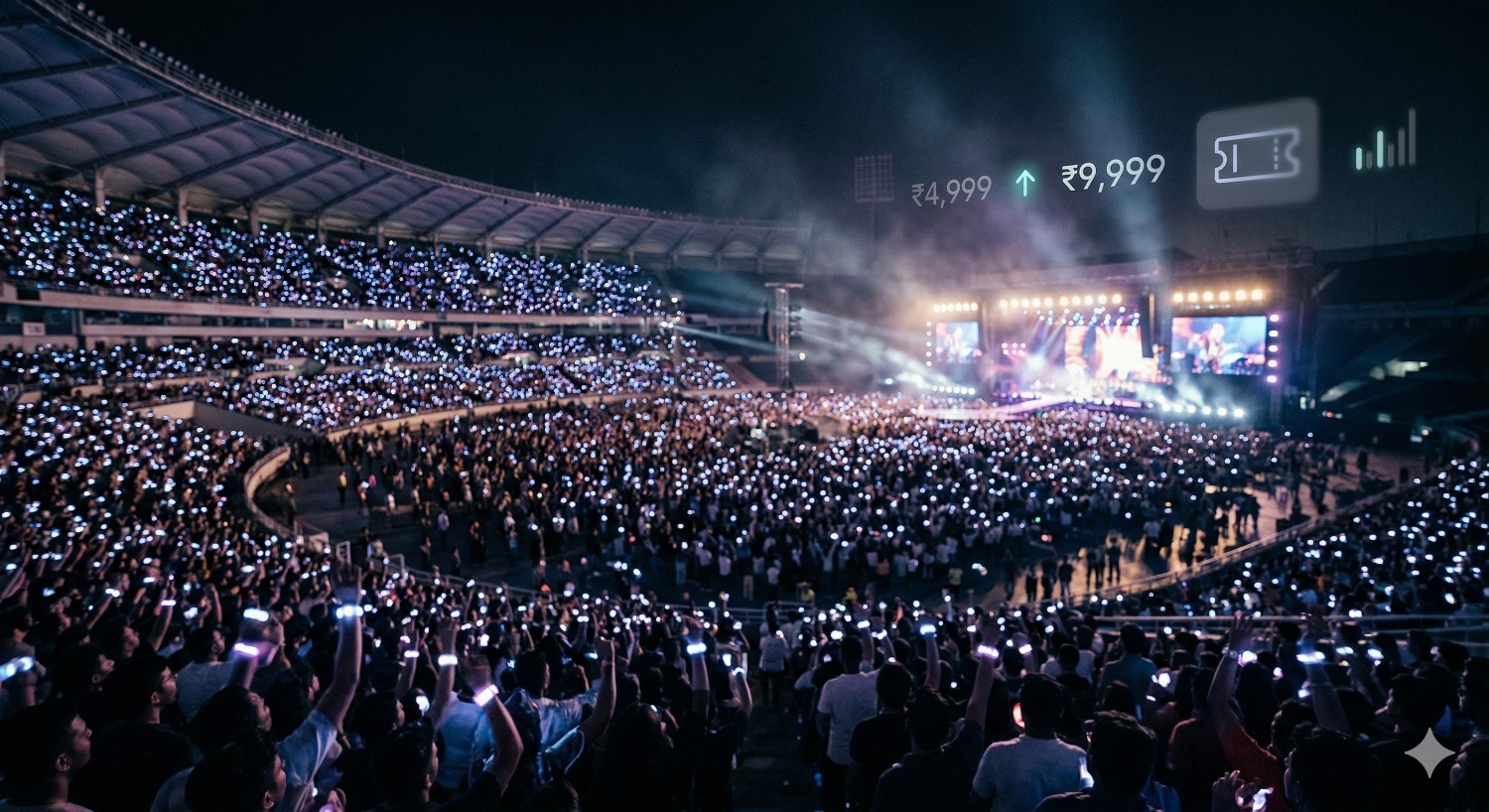
A fan logs in at noon, ready to buy tickets for a much-awaited concert. The price shows ₹4,999. Within minutes, sometimes seconds, it jumps to ₹9,999. A quick refresh, and the same section is now labeled “almost sold out.” A friend, sitting right next to them, sees a completely different price.
In India’s rapidly growing live entertainment market, buying a ticket is starting to feel less like a transaction, and more like navigating an algorithm.
Not an Isolated Incident: A Pattern Across Events
India is at an inflection point in its live events ecosystem, with global artists increasingly touring the country and audiences showing a stronger willingness to spend on experiences; the segment is estimated to be growing at a double-digit pace. However, this rising demand is colliding with limited venue capacity and a highly centralized ticketing ecosystem dominated by platforms like BookMyShow and District India, where access, visibility, and pricing are tightly controlled, creating the ideal conditions for dynamic, or at least perceived dynamic, pricing to emerge.
Consider the frenzy around Coldplay’s “Music of the Spheres” India concerts. Tickets sold out within minutes, leaving many genuine fans empty-handed. Almost instantly, resale platforms were flooded with listings at exponentially higher prices, ₹5,000 tickets being offered for ₹40,000 or more.
While the primary platform may not have explicitly labeled pricing as “dynamic,” the consumer experience told a different story - rapid price changes, limited visibility into inventory, and a sense of urgency driven by scarcity cues.
Now layer this with the anticipation around global artists like Travis Scott's "Circus Maximus Tour" India speculation. Even before official announcements or ticket releases, demand signals - search spikes, social media chatter, early registrations - begin shaping perceived scarcity. By the time tickets go live, the market is already primed for volatility.
The Real Problem: It’s Not the Price, It’s the Perception
At first glance, this appears to be a classic case of supply and demand - high demand, limited supply, and rising prices. But the issue here is not purely economic; it is behavioral. Indian consumers are already familiar with variable pricing across flights, hotels, and ride-hailing, yet the context of a concert is different. A ticket is not just a purchase, it is tied to emotion, identity, and anticipation. When pricing in such moments feels unpredictable or opaque, it shifts the reaction from acceptance to perceived unfairness.
1. Acceptance of high prices ≠ acceptance of unfair pricing
Consumers are willing to pay a premium for experiences. But when two people pay vastly different prices for the same seat, the issue shifts from affordability to fairness.
2. Lack of transparency breeds suspicion
Without clarity on how prices are determined, consumers begin to question the system itself. Is this genuine demand? Is inventory being withheld? Is pricing being manipulated?
3. Platforms are no longer neutral intermediaries
With control over both access and pricing layers, platforms are increasingly seen not just as facilitators, but as participants in value extraction.
From Fans to Traders: The Behavioral Shift
Perhaps the most under-discussed consequence of this shift is how it is changing consumer behavior. What was once a straightforward purchase is now becoming a strategic exercise.
- Users log in from multiple devices to increase their chances
- Groups coordinate to secure tickets faster
- Buyers think not just as fans, but as potential resellers
- FOMO-driven purchases are followed by post-purchase regret
In effect, the live event ecosystem is being subtly financialized. Tickets are no longer just access passes, they are assets with fluctuating value. And when that happens, the nature of engagement changes. The emotional connection weakens. The transactional mindset strengthens.
Where Data and Strategy Need to Evolve
This is where a more nuanced approach becomes essential. The challenge is no longer just about predicting demand, it’s about managing perception alongside performance.
Businesses need to move towards:
- Transparent pricing frameworks that clearly communicate how prices evolve
- Demand intelligence models that anticipate spikes without creating artificial scarcity signals
- Real-time sentiment tracking to understand how consumers are reacting, not just what they are buying
Because in experience-driven industries, perception is not a byproduct, it is the product.