From Personal Care to Precision Beauty
For decades, the beauty and personal care industry has been driven by intuition. Formulations were built on expertise, trends were shaped by culture, and products were designed for broad consumer segments. That model is rapidly evolving.
Today, beauty is becoming data-driven, personalized, and predictive. Artificial intelligence (AI) is at the center of this shift, enabling brands to move beyond one-size-fits-all offerings toward precision beauty, where products, recommendations, and experiences are tailored to the individual.
The question is no longer whether AI will transform the industry, but how deeply it will redefine it.
Why AI Adoption is Accelerating
Several structural shifts are driving the rapid adoption of AI across the beauty ecosystem.
First, the explosion of consumer data, including skin scans, purchase history, lifestyle inputs, and environmental factors, has created a strong foundation for intelligent systems to operate at scale. Second, the rise of e-commerce in beauty has introduced a fundamental challenge. Consumers can no longer physically try products before buying, and AI is increasingly filling this gap.
At the same time, consumer expectations have evolved. Today’s buyers are not looking for generic solutions. They expect personalized routines, real-time guidance, and measurable results. AI enables brands to deliver on these expectations while maintaining scale.
Where AI is Creating Tangible Impact
1. Hyper-Personalized Skincare and Diagnostics
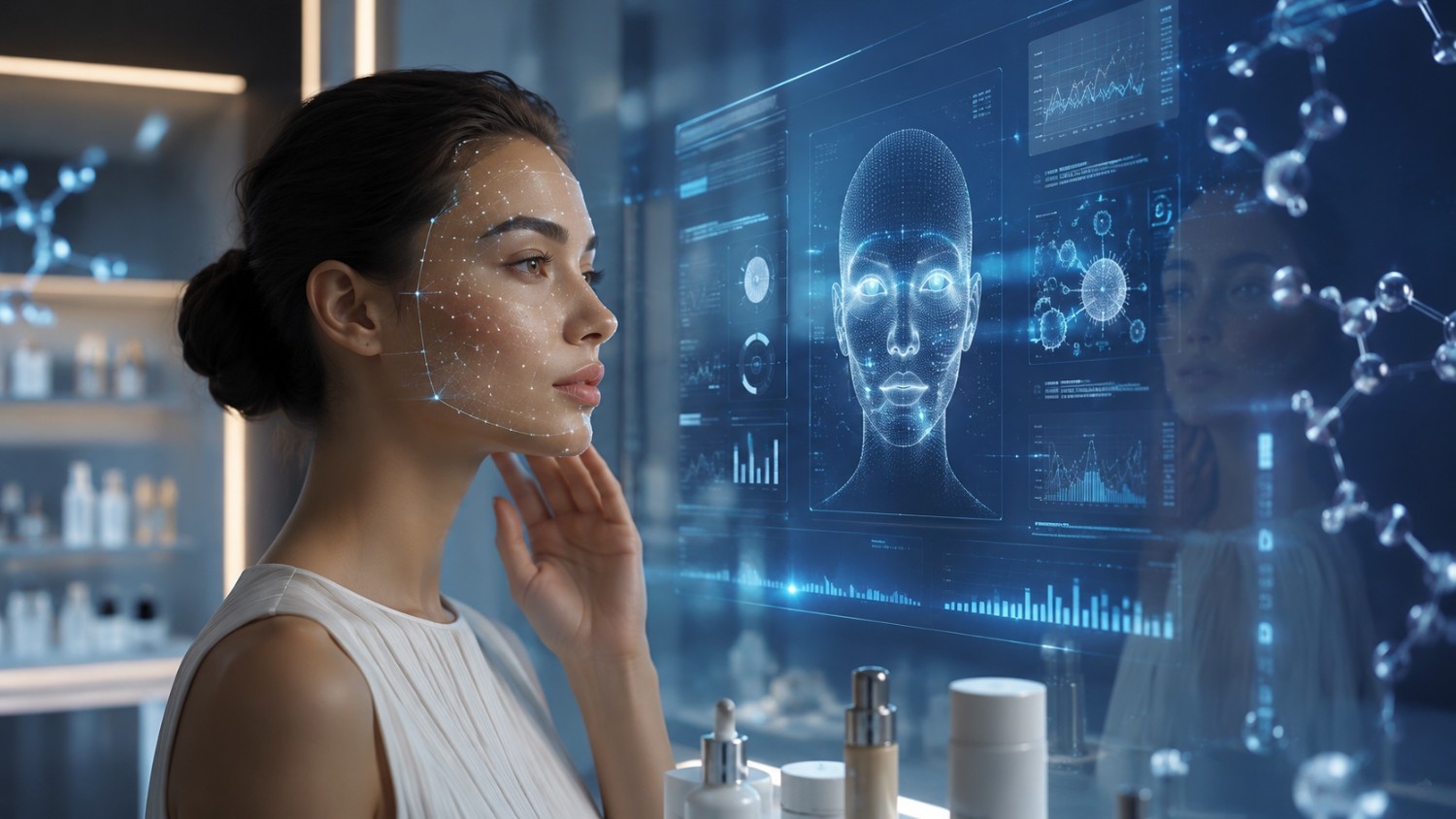
One of the most visible applications of AI in beauty is in skin diagnostics and personalized skincare.
Tools like Skin Genius by L'Oréal and Skin360 by Neutrogena use computer vision and machine learning to analyze skin conditions. These tools assess factors such as wrinkles, pores, hydration, and texture through a simple smartphone scan. These systems can evaluate multiple skin parameters with a level of consistency that rivals traditional consultations.
The result is a shift from static product recommendations to dynamic, personalized regimens that evolve over time.
For brands, this translates into higher consumer trust, improved engagement, and stronger repeat purchase behavior.
No7 Beauty x Revieve: No7 Beauty partnered with Revieve to implement an AI-powered skincare advisor that uses image analysis to assess skin concerns and recommend personalized routines. The results in 2024 were striking: users of the tool delivered 3.6× higher conversion rates and a 48% increase in average order value.
L’Oréal In-Store Diagnostics: L’Oréal deployed AI-powered skin diagnostics and personalized beauty routines in-store across 56 countries in 2024, through seven of its brands, including Lancôme and Kiehl’s. Up to 70% of consumers who experienced the diagnostic went on to purchase products.
2. Virtual Try-Ons and Augmented Reality Experiences
The inability to physically try products has long been a friction point in online beauty retail. AI-powered virtual try-ons, often combined with augmented reality, are addressing this challenge.
Retailers like Sephora have deployed tools such as Virtual Artist, allowing users to test makeup products digitally in real time. Meanwhile, ModiFace, acquired by L'Oréal, has become a backbone for virtual beauty experiences across multiple brands.
The business impact is significant. Virtual try-ons have been shown to increase conversion rates by up to 30 percent or more, while also reducing return rates by helping consumers make more confident purchase decisions.
Avon x Perfect Corp: Avon’s partnership with Perfect Corp on AI and AR technology resulted in a 320% increase in conversions and a 33% boost in average order value.
Sephora Virtual Artist: Sephora’s Southeast Asia deployment of its Virtual Artist AR tool delivered a 28% increase in feature adoption rates, a 16% uplift in usage per user, and an overall 48% increase in Virtual Artist traffic. Across the industry, Perfect Corp’s 2024 AI trends report found that brands broadly reported a 2.5× increase in sales conversion after implementing virtual try-on technology.
3. AI in Product Development and Ingredient Innovation
Beyond the consumer interface, AI is transforming the core of product innovation.
Companies like Debut are leveraging AI and biotechnology to accelerate ingredient discovery and formulation development. By simulating how compounds interact and predicting efficacy, AI can compress what traditionally took years of research and development into significantly shorter cycles.
This not only reduces costs but also enables brands to bring more targeted, science-backed products to market faster.
Unilever Dove Damage Therapy: Unilever’s use of AI at its Materials Innovation Factory - analyzing over 100,000 data points on hair properties - cut formulation cycles from five or six rounds down to just one or two, reduced concept-to-R&D-brief time from months to days, and made claims generation 75% faster. The resulting Dove Damage Therapy range drove double-digit growth for the brand in 2025, rolling out across more than 35 countries.
L’Oréal x IBM: In January 2025, L’Oréal and IBM announced a partnership to build a custom generative AI formulation model that extracts insights from thousands of formulation records - accelerating new product creation, reformulating existing lines, and optimizing large-scale manufacturing.
4. AI-Powered Recommendations and Conversion Engines
AI is also reshaping how consumers discover products.
Systems like Skin Advisor by Olay analyze facial data alongside lifestyle inputs to recommend tailored skincare solutions. Such tools have demonstrated measurable impact, including significant increases in conversion rates and engagement.
Similarly, platforms used by retailers like Sephora integrate AI into the shopping journey. These systems combine browsing behavior, purchase history, and preferences to deliver highly relevant product suggestions.
The outcome is not just improved conversion, but a deeper, more personalized customer relationship.
Olay Skin Advisor (P&G): P&G’s Olay Skin Advisor, which analyses selfies using deep learning to generate personalized skincare regimens, doubled Olay’s sales conversion rate, reduced the online bounce rate by one-third, and increased average basket size by 40% in China. The platform has engaged over 5 million global users, with 94% of consumers receiving unique, non-generic product suggestions.
5. AI in Marketing, Retail, and Customer Engagement
AI is extending its influence into marketing and customer experience.
From AI-generated creatives to personalized campaigns, brands are increasingly using machine learning to tailor messaging at scale. At the same time, conversational AI tools, such as virtual beauty advisors, are enabling real-time, always-on engagement.
For instance, L'Oréal’s AI-powered assistants guide users through product selection, skincare routines, and usage recommendations. This effectively replicates an in-store consultation in a digital environment.
This shift is redefining customer interaction. It is moving from transactional to continuous and advisory-led.
L’Oréal Beauty Genius: L’Oréal’s Beauty Genius AI assistant has generated over 1.1 million conversations in the United States, offering personalized recommendations and directing users to purchase points. The brand has reported significantly higher conversion rates and average order value among consumers who engaged with Beauty Genius versus those who did not.
Estée Lauder x Microsoft ConsumerIQ: Estée Lauder’s collaboration with Microsoft produced ConsumerIQ, an AI tool that enables the company to analyse vast consumer datasets to better meet consumer demands and predict market trends - accelerating the entire innovation pipeline from insight to launch.
The Longer Game
AI is delivering measurable results across the beauty industry. But as adoption scales and the technology matures, a set of harder, more strategic questions begins to surface - ones the industry has not yet fully reckoned with.
When everyone personalizes, does personalization lose its meaning?
Personalization is currently a competitive advantage, but it is one built on access to technology rather than proprietary insight. As AI diagnostics, virtual try-ons, and recommendation engines become standard infrastructure available via white-label platforms, the differentiation they offer might erode. The brands that win the next era may not be those that personalise best, but those that use personalization as a foundation to build something harder to replicate - a distinct point of view, a community, or a philosophy of beauty that AI can serve but cannot manufacture.
Will AI compress product differentiation itself?
AI is accelerating formulation - enabling brands to identify high-performing ingredient combinations faster and bring products to market in a fraction of the time. But if every major player uses the same AI formulation tools and ingredient databases, the logical endpoint is a convergence in what gets made. Products may become technically excellent but increasingly indistinguishable. The industry may be heading toward a paradox: the very technology designed to enable differentiation inadvertently drives commoditization. In this world, the disruptor may be the brand that deliberately walks away from the consensus the AI produces.
Does hyper-personalization create a new kind of beauty monoculture?
Recommendation systems are optimized for conversion, not for broadening a consumer’s sense of what beauty can mean. At scale, AI that surfaces “what works for your skin type” may quietly narrow the range of products consumers ever encounter - filtering out the unexpected and the experimental. The beauty industry has always been as much about aspiration and self-expression as efficacy. The risk is that AI, in solving for the rational, crowds out the irrational - which is where much of beauty’s cultural power has always lived.
Who owns the consumer relationship when AI intermediates it?
As AI assistants and conversational commerce tools become the primary interface between consumers and beauty products, a structural shift is underway. The brand is no longer speaking directly to the consumer - an AI layer sits in between. In the near term, brands control that layer. But as third-party AI platforms and agentic shopping tools become more prevalent, that control is not guaranteed. The brands that thrive will be those that invest early in owned AI relationships, proprietary data, and direct consumer trust - before the intermediary layer becomes someone else’s asset.
The disruptor may not look like a beauty company at all
In technology-intensive industries, the companies that redefine a category are often not the incumbents who adopted the new technology best, but the outsiders who used it to ask a fundamentally different question. The most significant disruption in beauty may not come from an established player building a better AI. It may come from a company that uses AI to make the existing product model unnecessary altogether - or from a diagnostic platform so trusted that the brand behind the recommendation matters less than the recommendation itself. The biggest risk for incumbents is not falling behind on AI adoption. It is winning the current game so completely that they fail to notice when the game changes.
Closing Perspective
The evidence is clear: AI is already delivering measurable impact across beauty, and the gap between early movers and the rest is widening.
But technology alone will not determine who leads the next chapter. The brands most likely to thrive will be those asking not just how do we deploy AI, but what do we want to build with it. That distinction - between adoption as an end and adoption as a means - may prove to be the most consequential strategic choice of the decade.
The future of the beauty segment will be defined not by the sophistication of the tools, but by the quality of the thinking behind them.