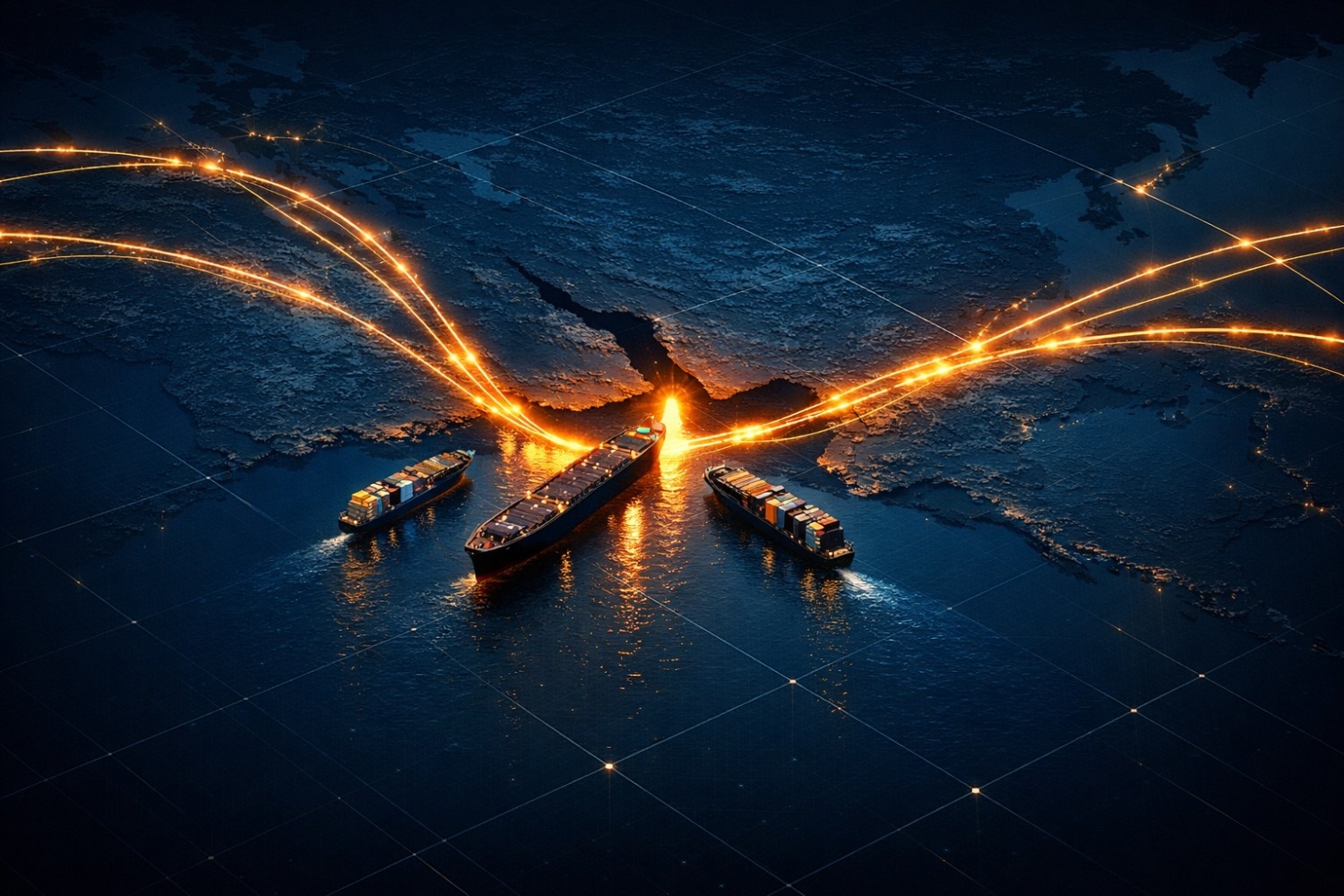
In times of stability, global supply chains operate almost invisibly. Goods move across oceans, energy flows through maritime corridors, and markets function with remarkable efficiency. Yet history repeatedly reminds us that these systems depend on a few critical arteries. When geopolitical tensions rise, those arteries suddenly become visible.
The ongoing conflict in the Middle East and the growing risks around the Strait of Hormuz illustrate precisely such a moment. What appears at first to be a regional security challenge carries far wider implications, touching energy markets, global trade routes, inflation, and ultimately business strategy. As global supply chains become increasingly interconnected, disruptions at key maritime chokepoints can trigger cascading effects across industries and economies.
Strategic Importance of the Strait of Hormuz
Few geographic chokepoints are as consequential to the global economy as the Strait of Hormuz. This narrow passage connecting the Persian Gulf to global markets handles roughly 20 million barrels of oil per day, close to one-fifth of global consumption, along with a significant share of the world’s liquefied natural gas trade.
A large portion of this energy ultimately flows toward Asia. Countries such as China, India, Japan, and South Korea depend heavily on shipments that transit through this corridor. Any disruption, therefore, has implications far beyond the Middle East, affecting not only oil prices but the stability of global energy markets.
Strategically, the Strait of Hormuz is far more than a shipping route. It represents one of the central pressure points of the modern economic system. When tensions rise around such chokepoints, the impact travels rapidly across continents, influencing energy prices, financial markets, and industrial production worldwide.
Ripple Effects on Global Supply Chains
Energy sits at the foundation of modern supply chains. When energy flows
are disrupted, the consequences ripple through transportation networks,
manufacturing systems, and agricultural production.
Recent geopolitical tensions have already begun tightening global fuel markets, particularly diesel, one of the most critical fuels for freight and logistics. Rising energy costs quickly translate into higher shipping rates, longer delivery times, and increased volatility in commodity markets.
History provides several examples of this dynamic. The oil shocks of the 1970s triggered prolonged inflation and reshaped global economic policy. More recently, the Russia-Ukraine conflict revealed how disruptions in energy and commodities can cascade through food supply chains, fertilizer production, and transportation costs worldwide.
Today’s supply chains are deeply interconnected. A disruption in one region rarely remains local; instead, it travels through logistics networks, financial markets, and industrial systems across the global economy.
Cost Transmission to Businesses and Consumers
Supply chain shocks rarely remain confined to energy markets. Instead,
they transmit through the economy in multiple layers. Higher energy prices
increase transportation costs. Transportation costs raise the price of raw
materials. These increases eventually reach consumers through higher retail
prices.
For businesses, the challenge is compounded by simultaneous pressure on
several fronts, including fuel costs, shipping insurance, inventory management,
and currency volatility. For energy-importing economies such as India, which
relies heavily on imported crude oil, these pressures can quickly translate
into broader inflationary effects.
In an environment where geopolitical risks increasingly shape trade routes and supply chains, relying on traditional assumptions about stable logistics and predictable costs can be increasingly risky. Organizations that continue to operate with strategies designed for a more stable global order may find themselves exposed to sudden disruptions, rising costs, and greater operational uncertainty.
Strategic Implications for Businesses
Perhaps the
most important lesson from current disruptions is that supply chain resilience
is no longer merely an operational concern; it is a strategic imperative.
For decades, globalization optimized supply chains primarily for
efficiency: just-in-time inventory, concentrated sourcing, and cost
minimization. The emerging geopolitical environment suggests a shift toward
diversification, redundancy, and strategic risk management.
Organizations are already responding by diversifying suppliers,
strengthening inventory buffers for critical inputs, and incorporating
geopolitical analysis into long-term planning. In this environment, supply
chains are no longer simply logistical networks; they are strategic
infrastructure that determines competitive resilience.
In periods of volatility, consistency in strategic decision-making
becomes a key competitive advantage. Companies that systematically build
resilience into their supply chains are better equipped to withstand
disruptions than those that respond to risks in an ad hoc manner.
The era of frictionless globalization is gradually giving way to a more complex landscape shaped by geopolitics, energy security, and strategic competition. For business leaders, the challenge is not merely to respond to disruption but to anticipate the structural shifts it reveals.
For more insights shaping global markets - Connect with us