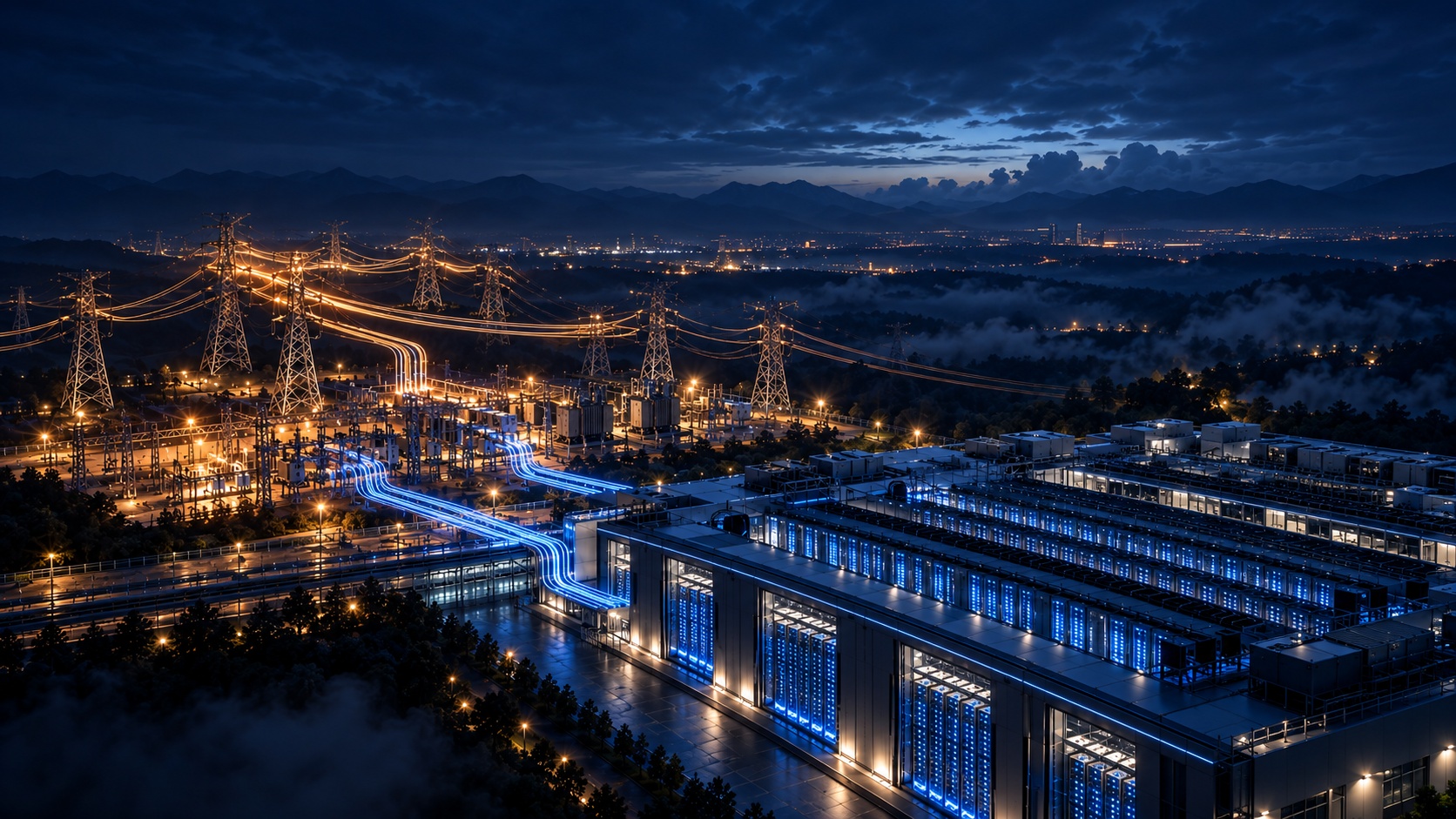
For the better part of three years, the AI buildout story has had a single bottleneck: chips. GPU lead times, export controls, fab capacity, Nvidia allocation politics: these were the variables that determined how fast any organization could scale its AI ambitions. That constraint has not disappeared, but it has eased considerably as chip supply has scaled and diversified across manufacturers and geographies.
A new constraint has taken its place, and it sits several layers below the silicon: electricity.
Global data center power demand is projected to rise 27% in 2026 alone, reaching 132 gigawatts worldwide, up from 104 gigawatts in 2025, according to Gartner. AI-optimized servers, which consumed 95 terawatt-hours of power globally in 2025, are on track to draw 175 terawatt-hours in 2026, an 84% jump, and will overtake conventional servers in power consumption by 2027, Gartner projects. The compute is available and being deployed. What is no longer available on the same timeline is the electricity to run it.
This is not a minor operational footnote. It is a structural shift in what actually limits AI capacity, and it has implications that extend well beyond IT infrastructure planning into how capital gets allocated and how deals get underwritten.
The Scale of the Gap
In the United States specifically, Bank of America estimates that data centers alone could add roughly 125 gigawatts of US electric load between 2026 and 2030, pushing overall US electricity demand growth to a 4.1% compound annual growth rate over that period. To put that in context, US electricity demand has grown at a fraction of that pace for most of the last two decades.
The US supply side is not keeping up. BofA projects the US will need more than 230 gigawatts of new generating capacity over the next five years, while regulated US utilities are on track to add only about 93 gigawatts of accredited supply. That leaves a gap of more than 100 gigawatts, and large gas turbines, the fastest conventional way to close it, are largely sold out through 2030. Developers are increasingly turning to on-site gas generation, battery storage, and extended coal plant operations to bridge the shortfall.
Globally, the picture is consistent. Gartner projects data center electricity consumption worldwide will exceed 1,200 terawatt-hours by 2030, more than double the roughly 565 terawatt-hours consumed globally in 2026, as grid supply struggles to keep pace with construction.
Why This Belongs in a Diligence Conversation, Not Just an IT One
For most of the last decade, power availability was a site-selection footnote, something operations teams confirmed late in the process. That is no longer defensible. Power access, interconnection queue position, and permitting timelines are now material variables that determine whether an AI infrastructure investment delivers on its projected timeline and returns.
This changes what diligence needs to surface:
- Interconnection queue position: A data center site with strong fiber connectivity and favorable tax treatment is still a stranded asset if it sits years back in a utility's interconnection queue.
- Utility capacity forecasts and their credibility: Utilities have revised their demand forecasts upward in each of the past three years as AI-related load materialized faster than expected, which means historical capacity plans are an unreliable guide to future supply.
- Dependence on on-site generation: Sites relying on gas turbines or diesel backup as primary power, rather than grid supply, carry a different cost and regulatory risk profile than sites with firm utility contracts.
- Regional exposure: Power availability varies sharply by geography. Some regions face years-long interconnection delays; others, with more headroom, are seeing only marginal tightening.
None of this shows up cleanly in public filings or investor decks. It requires the kind of ground-level, jurisdiction-specific intelligence that is difficult to assemble from desk research alone, which is precisely why it tends to get underweighted in fast-moving deal processes.
The Second-Order Winners
As the bottleneck shifts from chips to power, so does the set of businesses positioned to benefit from it, though the opportunity looks different depending on where a company sits in the value chain:
- Regulated utilities: Rising demand strengthens their case for rate-base growth and new capital expenditure approvals, though returns remain bound by regulatory frameworks and approval timelines.
- EPC and construction firms: Companies building out generation and transmission infrastructure face a multi-year project pipeline, with revenue visibility tied closely to permitting speed and utility capex cycles.
- Turbine and grid equipment manufacturers: With large gas turbines sold out through 2030, manufacturers of turbines, transformers, and grid hardware sit in a genuine seller's market. Backlogs, not demand generation, are now their primary constraint.
- Battery storage and on-site generation providers: These businesses are earlier-stage bets on how the gap gets bridged in the interim, carrying more technology and scale risk but potentially faster growth if on-site solutions become the default response to grid delays.
This matters for two distinct investor audiences. For those investing directly in energy and industrials, it reframes the growth case for assets that were previously valued on conventional utility economics. For private equity firms with AI-exposed portfolio companies, whether that exposure is direct infrastructure or downstream software and services, it means supply chain and cost exposure to power equipment and generation capacity now warrants the same scrutiny historically reserved for chip supply chains.
The Risk Cuts Both Ways
It is worth being precise about what kind of risk this creates, because it runs in two directions.
If AI demand growth decelerates from current projections, whether due to a pullback in enterprise adoption, a plateau in model capability gains, or macroeconomic pressure, regions and companies that have committed capital to power buildout on the assumption of sustained 25%-plus annual growth face overbuild risk and stranded assets.
If demand growth continues at or above current trajectories, the opposite risk dominates: underbuild, missed timelines, and projects that cannot secure power on the schedule their investment case assumed.
This is a scenario-planning problem, not a directional bet. Organizations and investors that build both cases into their underwriting, rather than anchoring to a single demand trajectory, will be better positioned regardless of which scenario plays out.
What This Means Going Forward
The chip shortage taught the market to price semiconductor exposure into every AI-adjacent investment thesis. The next several years will require the same discipline applied to power. Grid access, interconnection timelines, and generation capacity are becoming as material to valuation as customer contracts, technology differentiation, or management quality, and they deserve the same rigor in diligence.
The organizations that treat power as a strategic input, mapped early and monitored continuously, rather than an operational detail confirmed late in the process, are the ones best placed to capture the AI buildout's next phase rather than be constrained by it.