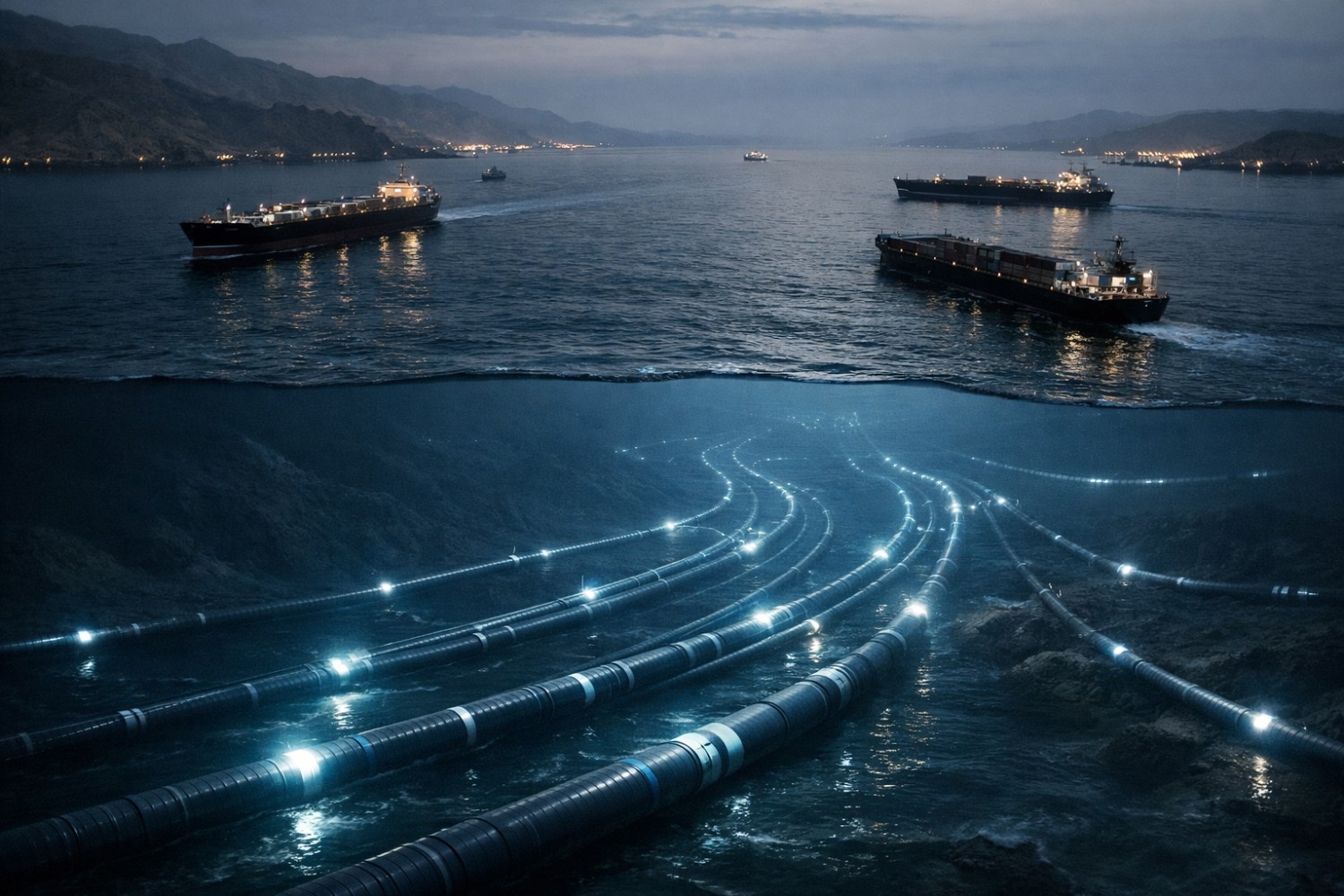
As geopolitical tensions escalate in the Middle East, much of the global focus remains on energy security, particularly the strategic importance of the Strait of Hormuz, through which roughly 20 to 25 percent of the world’s oil supply flows. Any disruption here has immediate implications for global energy markets.
But an equally critical and often overlooked question is emerging: Could conflict in this region also disrupt the global internet?
Beyond Oil: The Hidden Infrastructure Beneath the Sea
The Strait of Hormuz and the nearby Bab el-Mandeb Strait are widely recognized as vital maritime chokepoints. However, their importance extends far beyond shipping lanes. Beneath these waters lies a dense network of subsea fiber-optic cables that form the backbone of global digital connectivity.
These cables carry an estimated 95 to 99 percent of international data traffic, enabling everything from video calls and financial transactions to cloud computing and AI services. Contrary to popular perception, satellites account for only a small fraction of global data transmission. The internet, in its physical form, is largely underwater.
The Middle East, particularly the Red Sea and Arabian Gulf regions, serves as a critical junction connecting Europe, Asia, and Africa. Multiple high-capacity cable systems pass through or near the Strait of Hormuz and Bab el-Mandeb, linking major digital hubs across continents.
A Concentrated Risk Zone
One of the key concerns is not just the presence of these cables, but their geographic concentration. Industry estimates suggest that more than a dozen major subsea cable systems run through the Red Sea corridor alone, while several others connect through the Arabian Gulf. These routes are essential for countries like India, which rely heavily on westbound data flows to Europe and beyond.
This concentration creates a structural vulnerability. A single disruption may be manageable. Multiple simultaneous disruptions could have cascading global effects.
In recent years, there have already been instances due to accidents or natural causes where cable damage in this region has temporarily slowed internet speeds across parts of Asia and the Middle East. In a conflict scenario, the risks are significantly amplified.
Could Cables Be Targeted?
Subsea cables are not typically primary military targets, but they are strategically significant assets. Disrupting them does not shut down the internet globally, but it can slow connectivity, increase latency, disrupt specific regional data flows, and impact critical services that rely on real-time data exchange.
The challenge is that subsea cables are physically fragile and difficult to monitor continuously. They are often buried under the seabed but can still be exposed in certain areas.
In high-tension zones like the Red Sea, where Iran-backed Houthi groups have been active, there is growing concern that maritime infrastructure, including cables, could be at risk, either directly or as collateral damage.
The Repair Challenge in Conflict Zones
One of the most critical and underappreciated risks is not just damage, but repair complexity. Fixing subsea cables requires specialized repair ships, precise location mapping, and safe maritime conditions. Under normal circumstances, repairs can take days to weeks, depending on the depth and location of the damage.
In a conflict zone, this becomes significantly more difficult. Access to affected areas may be restricted. Repair crews face security risks. Military activity or blockades can delay response times. Even localized damage could result in prolonged disruptions, particularly if multiple cables are affected at the same time.
Implications for the Global Economy
The consequences of such disruptions extend far beyond slower internet speeds.
Financial systems and banking
Global financial markets rely on real-time data flows. Even minor latency issues can affect cross-border transactions, trading systems, and payment processing networks.
Cloud infrastructure and big tech
Major technology companies such as Amazon, Microsoft, and Google have invested heavily in data centers across the Middle East. These facilities depend on subsea cables for data synchronization, cloud service delivery, and enterprise operations. Any disruption could affect service reliability for businesses worldwide.
Enterprise operations and supply chains
Modern enterprises rely on globally distributed systems. From logistics tracking to remote collaboration, connectivity is critical. Disruptions can lead to delays, reduced performance, and increased operational risk.
India’s digital connectivity
India, as one of the largest digital economies, depends heavily on international cable systems for internet traffic to Europe and the United States, as well as for cloud and enterprise services. Disruptions in Middle Eastern cable routes could increase latency, force traffic rerouting, and impact service quality.
Why a Complete Internet Shutdown Is Unlikely
It is important to separate risk from exaggeration. No single country, even one located in a strategic region, can shut down the global internet entirely. The global network is highly redundant. Multiple cable routes exist across different geographies, and traffic can be rerouted dynamically.
However, redundancy does not eliminate impact. If multiple cables in a concentrated region are disrupted, traffic congestion increases, backup routes become overloaded, and performance degradation becomes widespread.
The internet may not go offline, but it can become slower, less reliable, and more fragmented.
From Connectivity to Resilience: A Strategic Imperative
For many organizations, digital connectivity is often assumed to be stable and always available. However, rising geopolitical tensions are beginning to expose the physical vulnerabilities of global digital infrastructure. This shift challenges a long-held assumption that the internet is inherently resilient and highlights how dependent businesses are on specific regions and underlying network pathways.
As a result, organizations must rethink how they view digital risk. Key questions emerge around reliance on certain geographies, third-party providers, and potential single points of failure within digital ecosystems. While businesses may not control the infrastructure itself, they need to better understand their exposure, assess risks across vendors and regions, and embed resilience into their operating models to navigate an increasingly uncertain environment.